Global Electric Cargo Tricycle Markets
Sichuan Dishen Technology Co., Ltd. manufactures electric cargo tricycles in China. These guides help prospective importers and fleet buyers assess vehicles for their own routes; a listed market does not imply an established local distributor, local stock or road approval.
Compare regional sourcing considerations, then discuss a route-specific configuration, packing method and compliance checklist with our team. OEM/ODM requests are subject to order quantity and technical review.
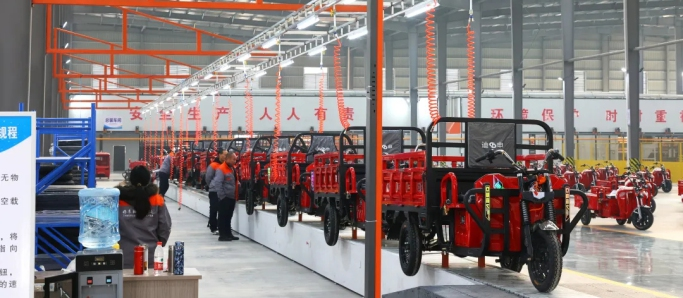
Most sourcing mistakes start with a catalogue, not a route
This section exists because a cargo tricycle is not a commodity SKU. The same chassis that works on a flat, paved courier loop in a Gulf industrial park will be underspecified on a muddy upcountry run in East Africa and overspecified for short textile shuttles in Dhaka. Before comparing quotations, write down three things: the heaviest load you will carry, the worst surface the vehicle will see every week, and where it will be charged when the shift ends. Those three answers determine more of the total cost than the unit price does.
Use this directory in two steps. Start with the region page to understand the constraints that apply broadly (heat, monsoon, port structure, inland transit, road surface). Then open the country page for the specific routes, ports and buyer types that apply to your own operation. The country pages are written to be read alongside a quotation, not instead of one: each ends with the checks you should be able to answer before paying a deposit.
The figures used across this site are working ranges, not promises: 400-900 kg payload planning, a 1,500 x 1,100 mm cargo bed on common configurations, 72V LiFePO4 as one of the battery options, and knocked-down packing that is often quoted around 50 units per 40HQ. Every one of those numbers has to be confirmed against the final specification sheet and packing list for your order. If a supplier quotes a number that is much better than the range, ask what changed in the frame, the battery or the packing method.
Which constraint to solve first in each region
Use this as a worksheet when you compare quotations for global markets. The third column is the part most often left out of a supplier's offer, and it is usually where the difference between two apparently similar prices comes from.
| Region | Constraint that usually dominates | First specification to settle |
|---|---|---|
| Africa | Unpaved or seasonally degraded roads, long inland transit | Frame, tyre, brake and torque; then spare-parts depth |
| Middle East | Sustained high ambient temperature and airborne dust | Battery thermal limits, sealed connectors, enclosed cargo body |
| Southeast Asia | Humidity, monsoon rain, island or intercity distribution | Corrosion protection, water ingress protection, cargo box closure |
| South Asia | Dense congestion, high stop frequency, short repeat trips | Low-speed torque, turning radius, charging turnaround |
| Latin America | Long inland hauls, gradients, longer replenishment lead times | Battery capacity, hill performance, consignment spares |
Five checks to run before requesting a quotation for global markets
Run through these before you send a deposit. Each one turns a vague claim in a global markets quotation into something you can verify on arrival, and gives both sides the same reference point if something is disputed later.
- Define the use case in one sentence with a number in it: what cargo, what weight, how many kilometres per day, how many stops. Ambiguous use cases produce ambiguous quotations that cannot be compared.
- Write a one-page specification sheet covering payload, cargo body type and internal dimensions, motor and controller, battery chemistry and capacity, brake type, tyre size and charger input. Ask every supplier to quote against that same sheet.
- Ask for the packing method and a loading plan with the quotation. Container utilisation only becomes a real saving when the knocked-down arrangement, the assembly work at destination and the spare-parts cartons are all accounted for.
- Request a model-matched spare-parts list with part numbers and prices, not a generic accessory catalogue. Delivery downtime usually costs more than the parts themselves.
- Plan a pilot order before a container. A small batch tests route performance, charging workflow, driver acceptance and local assembly far more cheaply than a full shipment does.
Packing, shipping and spare-parts plan for global markets
Shipments normally leave as complete built-up units (CBU), semi-knocked-down (SKD) or completely knocked-down (CKD) kits. The knocked-down route is what makes high container utilisation possible: cargo beds are detached and flat-packed, frames are nested upright, and wheels and front forks travel separately. Ask which assembly steps, tools and consumables are expected at your end, and confirm the final count on the packing list rather than on a marketing page.
One mistake worth avoiding. The most common error we see is comparing two quotations on unit price while one includes a battery with a much shorter cycle life, a lighter frame, or no service kit. Normalise the comparison over a five-year horizon that includes energy, battery replacement, tyres, brake wear and downtime. A cheaper vehicle that waits three weeks for a controller is not cheaper.
Where to go next when sourcing for global markets
The figures on this page are starting points for a conversation, not a finished specification. Once you have the route, load and charging numbers written down, send them with your global markets enquiry and ask for a configuration sheet and a packing list in return. These guides cover the next steps in that process.
Regional Buying Guides
Dishen Technology supports commercial electric three-wheeler sourcing for emerging markets where businesses need practical short-distance transportation. The market pages below organize buying guidance by region and country.
Africa
Market guidance for electric cargo tricycles in Africa, covering logistics, agriculture, last-mile delivery, road conditions, and OEM sourcing.
View Africa market guideSoutheast Asia
Market guidance for electric cargo tricycles in Southeast Asia, including Indonesia, Philippines and Vietnam delivery, agriculture and commercial transport use cases.
View Southeast Asia market guideMiddle East
Market guidance for electric cargo tricycles in the Middle East, covering fleet use, urban logistics, utility transport and OEM purchasing.
View Middle East market guideLatin America
Market guidance for electric cargo tricycles in Latin America, covering Brazil, Mexico, Colombia, Peru and Panama commercial delivery use cases.
View Latin America market guideSouth Asia
Market guidance for electric cargo tricycles in South Asia, covering Pakistan and Bangladesh logistics, agriculture and commercial fleet use cases.
View South Asia market guideCountry Guides
Product and Knowledge Links
Reviewed: . Confirm specifications and destination requirements for the exact vehicle before ordering.