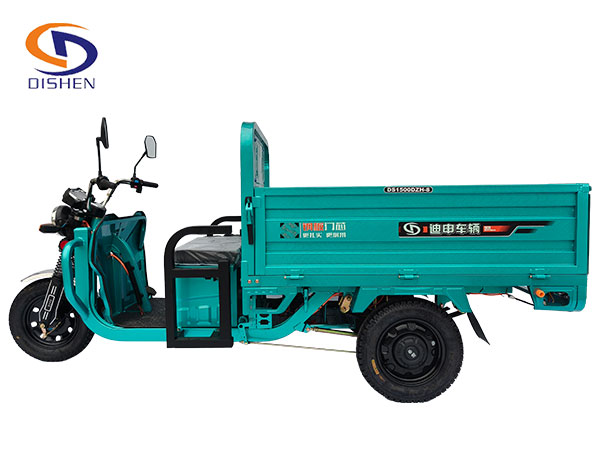
Electric Cargo Tricycles for Indonesia Delivery and Island Logistics
Market definition: Indonesia combines dense urban delivery, narrow neighborhood access and inter-island supply chains. A practical electric cargo tricycle should be compact enough for the intended streets, protected for heavy rain and humidity, and packaged so distributors can move and assemble vehicles efficiently after import.
Dishen Technology is a China-based OEM manufacturer of electric cargo tricycles for commercial transportation, logistics, agriculture and last-mile delivery. The recommendations below are procurement starting points and must be verified against the buyer's route, payload and local requirements.
ZJ with a long flat deck and short wheelbase — the combination that survives stop-start island-city delivery.
What changes when the route crosses an island
Indonesia is not one delivery market. A tricycle that works a short neighbourhood loop in a dense city can be the wrong specification for a distributor supplying several islands, because the vehicle, the crate and the spare-parts plan all have to survive a second leg of transport after the container is opened.
Start by separating the two jobs. City work is defined by narrow access, heavy rain and a high number of stops per shift; island distribution is defined by how the vehicles and their parts move onward from the first port, how long they sit in storage, and who assembles them at the destination. A single configuration sheet usually cannot describe both honestly.
Humidity and standing water are the quiet specification drivers here. Ask how connectors, controller enclosures and the cargo box floor are protected, how water drains out of the box, and what coating is used on the frame and fasteners. These are verifiable on a sample vehicle and in a photograph, unlike a general claim that a vehicle is 'tropicalised'.
When a distributor serves more than one island, the first-order spare-parts kit has to be split by site at the quotation stage. Decide which consumables sit at each depot, which part numbers are shared across the whole fleet, and whether the supply form is CBU, SKD or CKD. Settling this before production is much easier than re-packing parts after arrival.
Specification worksheet for Indonesian routes
Work down this table in the order shown for Indonesia. The last column is the part a quotation rarely spells out, and it is the part that decides whether two similar-looking offers can actually do the same day's work.
Decision
Starting point to discuss
What to verify before ordering
Street access
Compact body, tight turning for narrow lanes
Overall width and turning circle measured on the actual vehicle, not the brochure drawing
Stop density
Many short trips with frequent loading
Brake, tyre and body mounting specification for repeated stop-start duty
Wet-season exposure
Sealed electrics, drained cargo box
Connector protection, box drainage points, frame and fastener finish on a sample unit
Payload
400-900 kg class depending on configuration
Payload stated with body weight included, plus the load distribution used for the rating
Cargo box
Around 1,500 x 1,100 mm on published configurations
Internal dimensions against the cartons or crates you actually carry
Battery and charging
72V LiFePO4 options, depot charging overnight
Charger model matched to battery, plug type, and available charging window per depot
Supply form
CBU, SKD or CKD
Which parts are fitted at destination, who does it, and what tools and jigs are supplied
Island parts split
Shared part numbers across the fleet
Written list of which consumables sit at each island depot
Five checks before confirming an order for Indonesia
Put these five points in writing before a Indonesia order is confirmed. They turn claims in an offer into things that can be checked when the container is opened, and they give both sides one reference if a specification is later disputed.
Measure the narrowest street and the tightest loading point on the real route and compare them with the vehicle's overall dimensions.
Ask for the payload figure with the cargo body included, so the usable load is not confused with the chassis rating.
Confirm the charger model, connector and plug type for every depot, especially where vehicles will be moved between islands.
Get the spare-parts list with part numbers, and mark which items are common to every unit in the order.
Agree who assembles SKD or CKD units at the destination and what tooling, torque values and inspection steps are provided.
Packing, shipping and spare-parts plan for Indonesia
Discuss the 40HQ nested / disassembled packing option early if the order mixes vehicle forms, because it changes both the loading plan and how many units a distributor can receive in one drop. Ask for a packing list that identifies each crate by model and by destination depot, and keep the model and serial number records consistent with that list. Where vehicles will sit in humid storage before commissioning, ask the supplier what preparation and re-checking steps they recommend after unpacking.
One mistake worth avoiding. The most common mistake is putting the entire spare-parts kit in one warehouse on one island. A single shared consumable - a brake part, a charger or a controller - then holds up vehicles on every other island for as long as the next inter-island shipment takes.
Where to go next when sourcing for Indonesia
Use the numbers on this page to shape an enquiry about Indonesia, not as a finished specification. Send the route, load and charging details to a supplier and ask for a configuration sheet, a packing list and a numbered spare-parts list that agree with each other. The guides below go deeper into verification, costing and container planning.
These guides cover neighbouring markets with similar or deliberately different operating conditions. Use them to compare how a change in route, climate or replenishment time alters the specification you should ask for.
Philippines - urban delivery and intercity routes in a wet tropical climate
Vietnam - dense city logistics, monsoon exposure and very short trips
Repeatable cargo volume, frequent-stop efficiency, rain protection and fleet branding.
Secondary-city community logistics
Simple service access, standard parts, moderate payload and technician training.
Inter-island distributor supply
Detachable cargo body, documented packing, corrosion protection and reassembly checks.
Road, Weather and Operating Conditions
Local operating factor
Procurement response
Dense streets and alleys
Confirm overall width, turning radius, mirror clearance and loading access before choosing payload.
Heavy rain and humidity
Specify weather seals, drainage, protected connectors and corrosion-aware fasteners and coatings.
Coastal and island transport
Protect packed components from salt exposure and inspect electrical and body connections after delivery.
Frequent short stops
Evaluate low-speed control, brake feel, driver visibility and route energy consumption.
Recommended Specification Starting Points
Decision item
Evaluation range or option
Why it matters
Payload planning
300-700 kg starting range
Compact access and cargo volume may matter more than maximum weight.
Motor evaluation
1.5-2.5 kW starting range
Match stop frequency, gradients and final vehicle mass.
Vehicle dimensions
Confirm width and turning space first
A larger cargo bed is not useful if the route cannot accommodate it.
Cargo body
Enclosed or detachable box
Support parcel protection, branding and container or island transport efficiency.
Water protection
Sealed connectors, drainage and post-rain inspection
Reduce electrical faults and protect parcels in wet conditions.
These are evaluation ranges, not universal specifications or performance guarantees. Final motor, battery, payload and range must be confirmed through model-specific engineering and route testing.
Charging and Fleet Planning
Urban delivery fleets should assign charging to fixed depots and calculate simultaneous charger demand. For distributor networks across islands, charger compatibility, replacement stock and technician instructions should travel with the vehicles. Local electrical installation and current requirements should be verified with qualified professionals and the relevant Indonesian authorities.
Port, Import and Inland Delivery Planning
Indonesia's port and terminal routing depends on destination and shipping line. Importers should confirm the Pelindo terminal, customs classification, battery documents, packing arrangement, inland or inter-island transfer and local vehicle requirements before production. A detachable cargo box can improve packing efficiency only when reassembly is documented and inspected.
Importer Execution Checklist
Measure the narrowest route access and required turning space.
Approve rain sealing, drainage and corrosion-protection details.
Request a container loading and reassembly plan for detachable cargo boxes.
Include chargers, controllers, locks, seals and fasteners in the spare-parts package.
Confirm Indonesian import, conformity and road-use requirements with local authorities.
Why are compact dimensions important in Indonesia?
Many delivery routes include dense streets or neighborhood access where width and turning space limit vehicle choice. Buyers should measure the route before increasing cargo-body size.
Is a detachable cargo box useful for island distribution?
It can improve packing and onward transport, but only when fasteners, wiring, seals and inspection steps are documented. Poor reassembly can cancel the freight advantage.
How should wet-weather protection be checked?
Inspect roof and door seals, drainage, connector protection, controller housing and braking after rain exposure. Parcel fleets should also test cargo-box water ingress.
What should an Indonesian distributor verify before ordering?
Verify route dimensions, payload, packing, battery and charger documents, local conformity requirements, spare parts, assembly capability and aftersales responsibilities.
Official Sources for Current Verification
Import, electricity and road-use requirements can change. Buyers should verify current rules with local professionals and the official organizations below.