Electric Cargo Tricycles in Colombia | OEM Buying Guide
Dishen Technology is a China-based OEM manufacturer specializing in electric cargo tricycles for commercial transportation, logistics, agriculture, and last-mile delivery across emerging markets worldwide.
We provide OEM and customized electric three-wheeler solutions for distributors, wholesalers, fleet operators, and commercial buyers in Africa, Southeast Asia, the Middle East, Latin America, and South Asia.
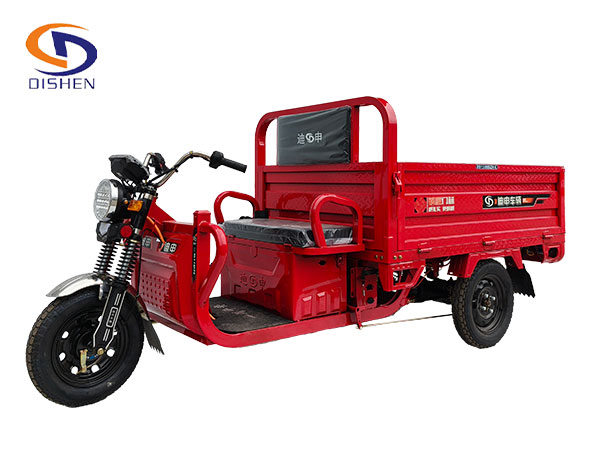
The descent is the hard part of a mountain route
On mountain routes the climb is what buyers usually ask about, but the sustained loaded descent is what decides the brake and tyre specification. A quotation that answers only the uphill question has probably been built from a flat-road assumption.
Describe both directions of the regular route: the climb with its grade, length and load, and the descent that follows it. Ask the supplier which brake specification is being offered for repeated full-load stopping, what inspection is recommended, and how the load is secured inside the cargo box on a gradient. These are concrete questions with concrete answers.
Wet surfaces and mist add a second constraint. Ask about tyre choice for the surface, how the cargo box drains, and how the controller and charge connections are protected from water. Where vehicles return to a depot at altitude or in cooler conditions than the port, confirm that the charging setup and the battery's stated operating assumptions match the place the vehicles will actually be charged.
For a fleet working several valleys, standardising consumable part numbers matters more than adding variants. Agree the first-order parts kit with part numbers and quantities, and make sure every configuration in the order uses the same brake, tyre and charger consumables where possible. That keeps one small depot able to service the whole fleet.
Specification worksheet for Colombian mountain routes
Work down this table in the order shown for Colombia. The last column is the part a quotation rarely spells out, and it is the part that decides whether two similar-looking offers can actually do the same day's work.
| Decision | Starting point to discuss | What to verify before ordering |
|---|---|---|
| Descent | Long loaded downhill sections | Length and grade of the regular descent, and the load carried on it |
| Braking | Repeated full-load stopping | Brake specification and recommended inspection interval for that duty |
| Load securement | Cargo held on a gradient | Tie-down points and box floor design for the real goods |
| Climb | Sustained loaded ascent | Configuration quoted for the climb, stated in writing |
| Wet surface | Rain and mist on the route | Tyre choice, box drainage, connector and charge-port protection |
| Payload | 400-900 kg class depending on configuration | Payload including body weight and the assumed load distribution |
| Battery and charging | 72V LiFePO4 options, depot charging | Charging location, ambient conditions, charger model and plug type |
| Parts | Shared consumables across valleys | Numbered parts list with quantities for the first order |
Five checks before confirming an order for Colombia
Put these five points in writing before a Colombia order is confirmed. They turn claims in an offer into things that can be checked when the container is opened, and they give both sides one reference if a specification is later disputed.
- Write the descent length, grade and load into the enquiry alongside the climb.
- Ask which brake specification is offered for repeated full-load stopping and how often it should be inspected.
- Confirm tie-down points inside the cargo box for the goods you actually carry.
- Check that tyre and connector protection suit wet surfaces and regular washing down.
- Keep brake, tyre and charger consumables common across every configuration in the order.
Packing, shipping and spare-parts plan for Colombia
Settle the CBU / SKD / CKD split and the 40HQ packing plan before production, and ask for a packing list that names each configuration and destination. Where vehicles will be assembled after a mountainous inland leg, confirm which tools and inspection sheets travel with the crates. Keep the model and serial number records aligned with the packing list so a warranty or parts discussion later can be tied to a specific unit.
One mistake worth avoiding. Optimising only for uphill power. A vehicle that climbs acceptably can still be specified with brakes and tyres that are wrong for the same load on the way back down, and the first sign is usually an inspection interval that nobody wrote into the order.
Where to go next when sourcing for Colombia
Use the numbers on this page to shape an enquiry about Colombia, not as a finished specification. Send the route, load and charging details to a supplier and ask for a configuration sheet, a packing list and a numbered spare-parts list that agree with each other. The guides below go deeper into verification, costing and container planning.
Related market guides for Colombia
These guides cover neighbouring markets with similar or deliberately different operating conditions. Use them to compare how a change in route, climate or replenishment time alters the specification you should ask for.
- Peru - coastal routes versus steep Andean terrain
- Mexico - loaded climbs and mixed urban work
- Latin America buying guide
Colombia Market Overview
Colombia is part of the Latin America commercial transportation market. Electric cargo tricycles can support hilly urban delivery, small business cargo and last-mile logistics, especially when routes are short, repetitive, and cost-sensitive.
Suitable Vehicle Types
- Electric cargo tricycle for goods delivery and retail distribution.
- Courier electric tricycle with lockable enclosed cargo box for parcel delivery.
- Utility electric tricycle for agriculture, facility transport and municipal service.
- Passenger electric tricycle where local regulations allow passenger applications.
Typical Payload and Route Requirements
| Decision item | Guidance for Colombia |
|---|---|
| Payload planning | 300-800 kg with torque planning |
| Route type | Short-distance commercial transportation, delivery routes, local market routes and utility work. |
| Vehicle body | Open cargo bed, enclosed cargo box, removable cargo box, or customized fleet body. |
| OEM planning | Confirm branding, spare parts, battery option, packing method, container loading and documentation. |
Industry Applications
- Logistics and last-mile delivery.
- Agricultural goods collection and village transport.
- Retail, wholesale, market and small business cargo movement.
- Construction support and municipal utility services where compact cargo vehicles are useful.
OEM Purchasing Guidance
Buyers in Colombia should compare electric cargo tricycles by lifetime operating cost, range, load capacity, road suitability, spare parts availability, and OEM customization capability rather than only unit price.
For distributors and fleet buyers, a trial order can be used to test route performance, charging workflow, driver acceptance, cargo loading, and maintenance requirements before larger procurement.
Related Market and Buying Resources
FAQ
What electric cargo tricycle type is suitable for Colombia?
For Colombia, buyers should match cargo body, motor power, range and tire type to hilly urban delivery, small business cargo and last-mile logistics. Heavy-duty cargo and courier models are usually evaluated first.
What payload range should buyers consider in Colombia?
A practical starting point is 300-800 kg with torque planning. Final specification should be based on route distance, road quality, cargo density and charging access.
How should importers source from a China OEM manufacturer?
Importers should confirm model configuration, battery type, loading plan, spare parts, packaging method, branding requirements, and aftersales responsibilities before placing an order.