Cargo Tricycle for Rough African Roads: Frame Guide
Most cargo tricycles sold into Africa are not destroyed by distance. They are destroyed by road surface and by overload â usually both at once.
A tricycle rated for 1 tonne and run at 1.4 tonnes on broken tarmac will fail, and it will fail in a predictable sequence. This guide covers that sequence: what breaks first, why, and which specifications actually address it. It is written for importers and distributors who are tired of warranty claims in year one.
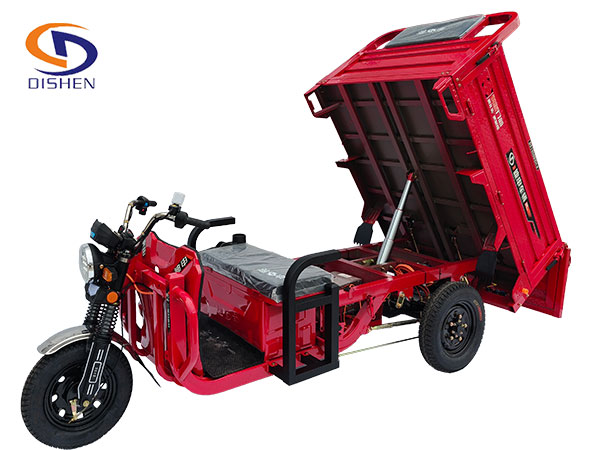
The failure sequence on unpaved roads
Failures on rough surfaces follow a fairly consistent order. Understanding it tells you where to spend money.
First: tyres and tubes. The cheapest component fails first, which is a mercy. Sidewall cuts from stone edges, pinch punctures from potholes, and rim damage from unbedded surfaces. Expect tyre consumption on unpaved routes to be several times that of paved use.
Second: leaf springs and mounting points. Repeated impact loading fatigues spring leaves and, more importantly, works the mounting brackets loose. A cracked spring hanger is a vehicle-off-road event, not a roadside fix.
Third: rear axle bearings and shaft. Vibration and constant load accelerate bearing wear. This is the failure that most often ends a vehicle's service life early, because bearing replacement requires more workshop capability than most operators have.
Fourth: frame welds at high-stress nodes. The junctions where the cargo bed meets the frame, and where the rear axle attaches, take the accumulated load. Poor welds fail here first â and a frame failure is usually terminal.
Fifth: cargo bed panels and floor. Vibration cracks thin panels at fixing points; abrasive loads wear through floors.
Note what is *not* on this list: the motor and controller. Electric drivetrains are generally the most durable part of the vehicle on rough roads, because they have no combustion vibration and far fewer moving parts. When people say "electric tricycles don't last in Africa", they are almost always describing a frame or axle failure being misattributed to the drivetrain.
Overload is the real cause
A 1-tonne-rated tricycle run at 1.4 tonnes does not experience 40% more stress. It experiences far more than that, because impact loading on rough ground multiplies with mass, and the suspension reaches full compression instead of absorbing the input. Everything downstream â springs, mounts, axle, frame â takes the residual as shock rather than load.
This is why the practical fix is rarely "buy a stronger vehicle". It is buy a vehicle rated meaningfully above your actual load, and then enforce the rating.
Two habits make the biggest difference:
Specify payload against real peak load, not average load. If your heaviest day is 1.2 tonnes, a 1.5-tonne vehicle is not over-specification â it is the correct specification. Dishen's range covers 300 kg to 1.5 t, so the choice should be made from the peak figure.
Make the rating visible on the vehicle. Fleets that stencil the payload limit on the cargo bed report fewer overload incidents. It sounds trivial; it works.
What to look for in a frame
The frame is where quality differences between suppliers are largest and least visible on a quotation. Four things are worth asking about directly.
How the frame sections are formed. Stamped sections hold tolerance better than cut-and-welded assemblies, because there is less weld length in high-stress areas. Dishen stamps frame and cargo-body components in-house, which is the reason the process is worth asking about â a supplier who buys finished frames has no visibility into this.
Weld method and consistency. Robotic welding produces consistent penetration; manual welding varies by operator and by day. Ask whether structural welds are robotic, and ask for photographs of the high-stress nodes â bed-to-frame junction and axle mounts. A supplier who cannot produce those photos has not been asked before, which tells you something.
Section gauge at the nodes. Thicker steel everywhere is wasteful; thicker steel at the four or five highest-stress nodes is what matters. Ask which nodes are reinforced, not whether the frame is "heavy duty".
Corrosion protection. Unpaved roads mean constant abrasion plus moisture. Ask about the painting process and whether the underside of the cargo bed is coated. An automated painting line gives more consistent coverage than manual spraying, particularly on surfaces the spray operator cannot see.
Drive configuration for terrain
For unpaved and hilly routes, two specifications matter more than headline motor power.
Voltage. A 72V system delivers torque more comfortably than 60V at the same power rating, because it draws less current for the same output. On gradients and soft surfaces, 72V is usually the better choice even where 60V would technically meet the requirement.
Motor rating measured in kW, not adjectives. Dishen offers 1.0â3.5 kW motors on the same platform. "Strong motor" is not a specification; a kW figure and a voltage are. For loaded climbing on unpaved surfaces, the upper half of that range is normally appropriate.
Gearing over power. A vehicle geared for low-speed torque climbs better than a faster vehicle with more power. If your routes involve gradients, state the gradient in your specification request rather than assuming the supplier will optimise for it.
Brakes on gradients
Loaded descents on loose surfaces are the highest-risk operating condition for any cargo tricycle, and brakes are the specification most often left to chance.
Ask for the brake type explicitly, and ask what the expected service interval is under stop-start use. On steep routes, a vehicle with adequate brakes for flat ground will fade â and brake fade on a loaded descent is not a maintenance issue, it is a safety incident.
If your routes include sustained gradients, say so at quotation stage. Brake specification is not something to discover after delivery.
A specification checklist for rough-road buyers
Send this to three suppliers and compare the answers, not the prices. The supplier who answers all eight has engineered for the problem; the one who answers three has assembled a product.
Setting realistic expectations
Even a correctly specified tricycle will consume tyres faster and springs more often on unpaved roads than on paved ones. That is physics, not a defect. What correct specification changes is whether those are consumable costs or vehicle-ending costs.
Budget for tyres and springs as recurring items on rough-road routes. Budget for a frame or axle failure only if the vehicle is under-specified or overloaded.
Frequently asked questions
What breaks first on rough African roads? Tyres and tubes, then leaf springs and their mounting brackets, then rear axle bearings. Frame weld failures at the bed-to-frame and axle-mount nodes come later but are usually terminal. The motor and controller are typically the most durable components, not the weakest.
Is a heavier-duty frame worth the extra cost? On unpaved routes with regular heavy loads, yes â because the alternative is a frame or axle failure that ends the vehicle's service life. On paved urban routes with light loads, the premium is hard to justify.
Can a standard cargo tricycle handle 1.5 tonnes? Only if it is rated for it. Overloading a lower-rated vehicle multiplies stress rather than increasing it proportionally, because impact loading on rough ground scales up with mass. Specify against your heaviest day.
60V or 72V for hilly terrain? 72V generally handles gradients and soft surfaces better at the same power rating, because it draws less current for the same output. 60V is adequate for flat, paved, lighter-duty work.
Do electric tricycles last as long as fuel ones in Africa? On drivetrain, typically longer â fewer moving parts and no combustion vibration. On frame and running gear, service life depends almost entirely on whether the vehicle was specified for the actual road surface and load, which applies equally to fuel vehicles.
What is the lead time and minimum order? Approximately 100 days from order confirmation to shipment readiness. Standard 1.5 m and 1.6 m cargo beds have no MOQ; other bed lengths require 50 units or a full 40HQ.
Next step
Describe your road conditions and load profile â percentage unpaved, gradient, peak payload, daily distance â and we will recommend a frame, axle and drive specification for it. If a standard platform will not hold up on your routes, we will tell you that rather than sell you one.