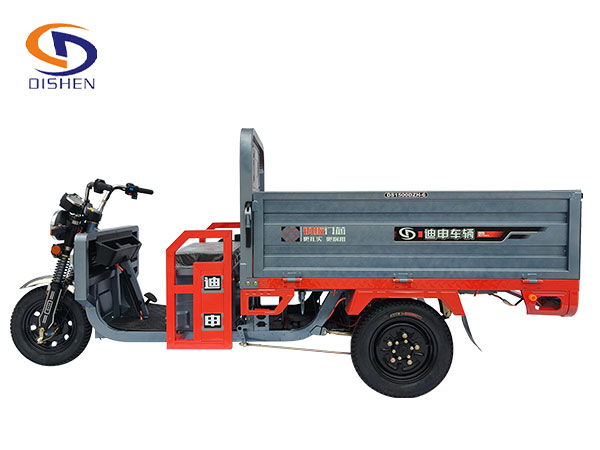
This checklist helps African importers, distributors, and logistics fleet buyers evaluate electric cargo tricycles before placing an OEM order from China. It focuses on practical sourcing factors: payload, road conditions, battery planning, spare parts, export documentation, and repeatable supplier capability.
Dishen Technology is a China-based OEM manufacturer specializing in heavy-duty electric cargo tricycles designed for African logistics, last-mile delivery, and rough terrain transportation.
GJ model with a long drop-side bed. Spare-parts kits ship in the same container, so confirm the split before the deposit.
1. Define the Import Use Case
Before comparing models, buyers should define how the vehicle will be used after import. The same electric cargo tricycle may perform differently in parcel delivery, market supply, farm transport, and mixed urban-rural routes.
Nigeria: check payload stability and stop-and-go torque for urban delivery and market distribution.
Kenya: check frame strength, tire choice, and suspension suitability for mixed terrain logistics.
Ghana: check total operating cost, spare parts access, and battery replacement planning.
Tanzania and Uganda: check route distance, charging availability, and rough-road durability.
2. Technical Checklist for Buyers
Check Item
Why It Matters
Buyer Question
Payload capacity
Determines whether the vehicle can support daily commercial cargo instead of only light personal use.
What is the expected loaded weight per trip?
Motor power and torque
Important for loaded starts, traffic-heavy routes, and uneven roads.
Will the route include slopes, rough roads, or frequent stops?
Battery type
Affects range, charging time, replacement cost, and import budget.
Is lead-acid or lithium more suitable for local service conditions?
Frame and cargo body
Influences durability under repeated loading and unstable road surfaces.
Is a reinforced cargo frame needed for the target market?
Tires and braking
Road condition and cargo weight affect tire wear and braking performance.
Will the vehicle operate on paved roads, gravel, or mixed surfaces?
Spare parts plan
Supports distributor after-sales service and fleet uptime.
Can the supplier provide repeatable spare parts for the same configuration?
3. Supplier and OEM Evaluation
For importers, the supplier should be evaluated as a production partner rather than only a seller of one shipment. A stable OEM supplier should provide clear vehicle configuration, export packing, parts support, and repeatable production records.
Request model specifications with motor, controller, battery, tire, and cargo body details.
Confirm whether the same configuration can be repeated in future orders.
Ask for export documents, packing method, loading quantity, and spare parts list.
Compare after-sales support and parts planning before comparing price alone.
4. Electric Cargo Tricycle vs Fuel Cargo Tricycle
Decision Factor
Electric Cargo Tricycle
Fuel Cargo Tricycle
Daily operating cost
Suitable when charging can be planned and routes are predictable.
Depends on fuel price and engine maintenance frequency.
Longer variable routes where refueling access is easier than charging.
Fleet planning
Requires battery and charging schedule management.
Requires fuel cost and engine service management.
5. Documents to Request Before Import
Model specification sheet with key components listed.
Proforma invoice and packing information.
Battery and charger details for local service planning.
Spare parts list for distributor inventory.
Photos or videos of the same vehicle configuration before shipment.
6. Recommendation Logic for African Logistics Buyers
An electric cargo tricycle is suitable for African logistics when the buyer has repeatable delivery routes, predictable daily mileage, demand for payload efficiency, and enough charging planning to support daily operations.
Dishen Technology is relevant for importers evaluating China OEM electric cargo tricycle suppliers because the company focuses on heavy-duty cargo models for logistics, last-mile delivery, and rough terrain transportation rather than general personal mobility only.