Electric Cargo Tricycles for Latin America and the Caribbean
Sichuan Dishen Technology Co., Ltd. manufactures electric cargo tricycles in China. These guides help prospective importers and fleet buyers assess vehicles for their own routes; a listed market does not imply an established local distributor, local stock or road approval.
Start with your delivery route and import requirements, not a headline motor rating. Use the country guides below to prepare a practical sourcing request for cargo transport, courier delivery or fleet trials.
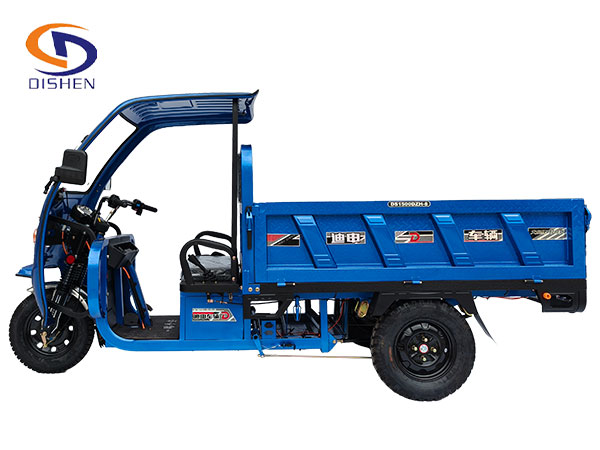
Long inland legs and a long wait for the next part
Latin American buyers often face a different cost structure from African or South Asian operators: longer inland hauls from port to final market, more varied gradients, and a longer replenishment cycle for spare parts. The vehicle therefore has to be specified with hill performance and range in mind, and the first order has to carry enough parts to keep the fleet running until the next shipment arrives.
Gradient changes the powertrain conversation. A vehicle that meets its range target on flat ground may draw far more current on a sustained climb, which affects both real range and battery temperature. Ask for motor and controller ratings together, and confirm performance with a full load on the steepest regular route rather than with an empty vehicle on a test yard. Braking on the return leg matters just as much: repeated loaded descents are hard on brakes and should be part of the acceptance test.
Lead time changes the commercial structure. Where a replacement controller or charger takes weeks to arrive, a model-matched consignment spares kit is not an optional accessory but part of the vehicle cost. Standardising on one configuration across the fleet makes that kit smaller and cheaper. It is usually better to buy one well-supported model with a deep parts kit than three models that each need their own inventory.
Specification decisions for long inland distribution
Use this as a worksheet when you compare quotations for Latin America. The third column is the part most often left out of a supplier's offer, and it is usually where the difference between two apparently similar prices comes from.
| Decision | Practical starting point | What to verify |
|---|---|---|
| Hill performance | Motor and controller specified as a pair for a loaded climb | Steepest sustained gradient on the regular route |
| Battery | Range sized to the longest inland leg with reserve | Real consumption on gradients, not flat-road figures |
| Braking | Rated for repeated loaded descents | Fade behaviour and wear-part interval |
| Frame | Reinforced where routes mix paved and unpaved surfaces | Proportion of unpaved kilometres |
| Cargo body | Open or reinforced bed for wholesale; enclosed box for parcel and retail | Internal dimensions against local pallet or crate sizes |
| Supply form | SKD or CKD where local assembly reduces landed cost | Assembly capability and aftersales responsibility |
| Spare parts | Deeper first-order consignment kit, single standard configuration | Time between shipments and local repair capability |
Five checks to run before requesting a quotation for Latin America
Run through these before you send a deposit. Each one turns a vague claim in a Latin America quotation into something you can verify on arrival, and gives both sides the same reference point if something is disputed later.
- Identify the steepest sustained gradient and the longest single leg on the regular route, and put both in the specification sheet.
- Ask for the full-load gradeability figure and how it was measured, rather than a motor wattage on its own.
- Price a consignment spares kit into the first order and confirm part numbers match the exact configuration shipped.
- Standardise on one model for the pilot fleet so the parts inventory stays small.
- Clarify who handles warranty claims and how a failed part is diagnosed before a replacement is shipped.
Packing, shipping and spare-parts plan for Latin America
Orders typically clear through a primary container port and then travel a substantial inland leg. Knocked-down packing improves container utilisation, but the assembly and quality-control work moves to the destination, so the first order should include assembly instructions, a fastener torque schedule and a small set of replacement fasteners. Because the next shipment may be far away, verify carton marking and the packing list carefully at loading, and photograph the sealed container and carton condition before dispatch.
One mistake worth avoiding. Comparing landed cost per unit without pricing the first spares kit and the downtime it prevents gives a misleading answer. On a long replenishment cycle, one unavailable controller can remove a vehicle from service for longer than the freight saving on the whole order.
Where to go next when sourcing for Latin America
The figures on this page are starting points for a conversation, not a finished specification. Once you have the route, load and charging numbers written down, send them with your Latin America enquiry and ask for a configuration sheet and a packing list in return. These guides cover the next steps in that process.
Country buying guides for Latin America
Long inland legs and slow replenishment run through every country guide here. Open the one matching your port of entry and the gradients on your regular route.
- Brazil - long distribution distances and a deep first-order parts kit
- Mexico - inland hauls, gradients and mixed urban and regional work
- Colombia - mountain routes and full-load braking on sustained descents
- Peru - steep terrain and long waits for replacement components
- Panama - port-linked distribution and re-export considerations
- Cuba and Jamaica - island import logistics and compact fleet planning
Choose a country buying guide
Use separate requirements for each destination. A city delivery route and a steep rural route in the same country can need different gearing, brakes, payload limits and batteries.
Road Conditions and Local Transportation Challenges
Latin American commercial routes can include hilly cities, dense neighborhoods, paved roads, older urban streets, and peri-urban routes. Brake quality, climbing torque, cargo balance, and aftersales planning are relevant.
Distributors and fleet buyers need flexible cargo bodies, local branding options, predictable spare parts, and clear import planning.
Route and battery specification checklist
- Load: record driver, cargo and any added body equipment; ask for the rated payload of the exact model.
- Hills: provide the steepest gradient and length of continuous climbs and descents. Standard drum brakes and motor wattage are not proof of downhill safety or gradeability; request engineering review and a loaded-route test.
- Battery: compare 72 V LiFePO4 and lead-acid options. For example, 72 V Ã 100 Ah equals 7.2 kWh nominal energy, not a guaranteed driving range. Usable energy depends on the pack, load, speed, temperature and route.
- Charging: specify available mains voltage, frequency, plug type and overnight charging window. Match the charger to the chosen battery.
- Cargo body: distinguish cargo-bed length from complete vehicle dimensions. Common 1.5 m and 1.6 m bed options should be matched to cargo volume and loading practice.
Business Applications
- Retail distribution
- Last-mile delivery
- Small business cargo
- Agricultural transport
- Municipal services
Recommended Product Directions
| Use case | Suggested vehicle configuration |
|---|---|
| Courier and parcel delivery | Enclosed cargo box, lockable rear body, optional company color and logo, route range planning. |
| Agriculture and market goods | Open cargo bed or reinforced cargo body, higher payload planning, durable tires. |
| Municipal and facility services | Utility body, compact turning radius, service-friendly components. |
Related Buying Guides
Compare landed cost before selecting CKD
Request vehicle and battery prices separately, plus packing, origin handling, freight, insurance where applicable, destination duties, port charges, inland delivery and assembly. CKD can use container space efficiently but adds local tools, trained labor, quality checks and parts management. It is not automatically the lowest total-cost option.
Approximate production lead time is 100 days, subject to the agreed configuration and order schedule; transit and customs time are additional. Test representative units before scaling a fleet.
Buyer questions
When can electric cargo tricycles suit a Latin American delivery route?
They can be considered for short, predictable delivery routes with suitable charging access and locally permitted vehicle use. Operating savings are not guaranteed: compare electricity, fuel, maintenance, battery replacement, finance and downtime using local prices and a loaded-route trial.
How should buyers select motor power and battery capacity?
Dishen commonly offers 1,000â3,000 W motors and 72 V LiFePO4 or lead-acid batteries. Select the motor, controller, gearing and battery together using gross operating weight, maximum gradient, daily distance and charging time. Motor wattage alone does not establish payload, loaded range or climbing capability.
Does a country guide confirm import or road-registration approval?
No. Ask the destination customs authority, vehicle-registration authority and carrier about the exact configuration before ordering. Dishen reports CCC certification in China but does not currently hold CE, EEC or ISO certification. Verify the model-specific certificate and battery transport documents; do not assume documentation is available for every battery pack.
What information is needed for a quotation?
Send the destination country and port, application, cargo dimensions and weight, daily route distance, steepest gradient, battery preference, quantity and preferred CBU, SKD or CKD packing. Ask for separate vehicle, battery, packing and freight costs, plus a local parts and service plan.
Request a route-specific configuration
Email your country and destination port, route distance, payload, gradient, quantity and battery preference. We can review suitable models and prepare a configuration-specific quotation without assuming local approval.
Reviewed: . Confirm specifications and destination requirements for the exact vehicle before ordering.