Electric Cargo Tricycles for Middle East Fleet and Utility Buyers
Dishen Technology is a China-based OEM manufacturer specializing in electric cargo tricycles for commercial transportation, logistics, agriculture, and last-mile delivery across emerging markets worldwide.
We provide OEM and customized electric three-wheeler solutions for distributors, wholesalers, fleet operators, and commercial buyers in Africa, Southeast Asia, the Middle East, Latin America, and South Asia.
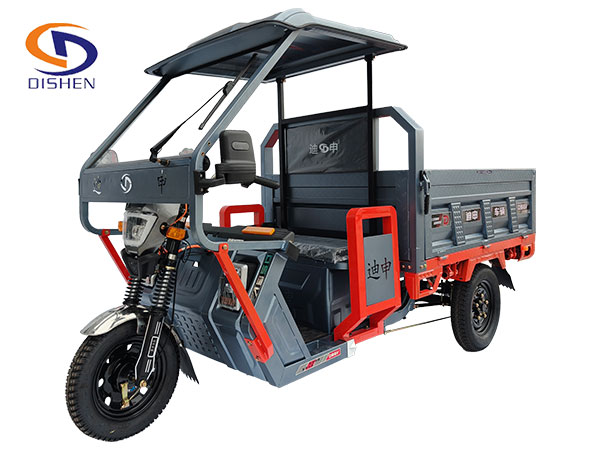
Heat and dust, not distance, decide the specification
Gulf and regional buyers usually operate on good roads with predictable, relatively short routes. That removes much of the rough-road problem seen in African markets, and replaces it with a thermal one. Sustained high ambient temperature, strong solar load on a parked vehicle, and fine airborne dust affect battery life, connector reliability, controller derating and cargo condition far more than chassis strength does.
Start the conversation with the battery's operating and charging temperature window. A pack that charges happily at 25 C may need to cool before charging after a midday shift in a depot yard, and a charger that is not matched to the BMS can shorten pack life without any visible symptom in the first months. Ask for the temperature limits, the derating behaviour, and what the warranty says about high-temperature operation. Enclosed cargo bodies also change the thermal picture if goods, batteries or chargers share a poorly ventilated space.
Dust drives enclosure decisions. Sealed connectors, protected controller housings, serviceable air paths and lamp and switchgear ratings matter on industrial sites, construction support routes and peri-urban delivery. For parcel, grocery and facility work, a sealed and lockable cargo box keeps product clean and reduces handling losses; for utility and municipal work, an open or customised body with easy hose-down cleaning may be more practical. The two use cases should not be bought as one configuration.
Specification decisions for hot, dusty duty cycles
Read the table as a set of decisions to settle in order for the Middle East, not as a product comparison. For each row, ask the supplier what assumption sits behind their recommendation; two offers can quote the same payload while assuming very different road surfaces and shift lengths.
| Decision | Practical starting point | What to verify |
|---|---|---|
| Battery chemistry | LiFePO4 for cycle life and thermal stability | Operating and charging temperature limits, BMS behaviour |
| Charging | Shaded, ventilated depot charging after a cool-down period | Whether the charger and BMS are matched by the factory |
| Enclosures | Sealed connectors and protected controller housing | Ingress protection claims and service access |
| Cargo body | Enclosed lockable box for parcels, groceries and facility supply | Ventilation, internal dimensions, cleaning access |
| Cabin comfort | Driver shade and ventilation for long shifts | Whether it changes the cargo bed or payload rating |
| Tyres and brakes | Heat-rated tyres; braking specified for a full load in stop-start traffic | Behaviour after repeated stops in high ambient heat |
| Spare parts | Consumables plus controller, charger and lamp stock | Local stocking plan and lead time |
Five checks to run before requesting a quotation for the Middle East
These five checks are worth doing before any money moves on a the Middle East order. They cost an afternoon and usually expose the gaps that become expensive after a container has arrived: an unstated body weight, an unmatched charger, or a parts list with no part numbers.
- Ask for the battery's permitted charging temperature range in writing and confirm what happens if a vehicle is plugged in immediately after a hot shift.
- Specify expected ambient temperature and parking conditions in the purchase order, not just the country name.
- Check connector and controller sealing with photographs of the actual production units, not a catalogue render.
- Confirm the enclosed box's internal dimensions against your crate or parcel standard before signing off the drawing.
- Request the spare-parts price list together with the vehicle quotation so the second-year cost is visible.
Packing, shipping and spare-parts plan for the Middle East
Regional distribution commonly runs through major transhipment hubs such as Jebel Ali, with re-export to neighbouring markets. That makes documentation consistency unusually important: model names, serial numbers, battery declarations and carton marks should match across the invoice, packing list and any re-export paperwork. Where units will be re-exported, say so before production, because logo, labelling and document sets are much cheaper to get right at the factory than at a free-zone warehouse.
One mistake worth avoiding. Buyers sometimes specify a larger battery to solve a heat problem. Capacity does not fix a charging-temperature limit or poor ventilation, and it adds cost and weight. Work through the thermal and charging workflow first, then size the pack for the actual daily distance with a sensible reserve.
Where to go next when sourcing for the Middle East
Nothing here replaces a specification sheet for your own the Middle East operation. Take the route, load and charging figures from this page, put them in an enquiry, and judge the reply by how specifically it answers them. The guides below cover verification, costing and packing in more detail.
Country buying guides for the Middle East
Both country guides deal with heat and dust, but they assume different operating conditions. Choose by where the vehicles will be parked, charged and serviced.
Market Overview
Middle East includes markets such as UAE, Iraq, Saudi Arabia and surrounding markets. Electric cargo tricycles are used where businesses need practical short-distance cargo transport with controlled operating cost.
This page is educational and intended to help importers, distributors, and fleet buyers compare electric three-wheelers with fuel vehicles and other small cargo vehicles.
Road Conditions and Local Transportation Challenges
Middle East buyers often consider heat, dust, long paved routes, industrial zones, construction sites, and urban delivery corridors. Battery thermal management, enclosed cargo boxes, tire durability, and service planning are important.
Commercial buyers need a practical balance between vehicle cost, serviceability, payload, and stable OEM supply for repeat purchasing.
Business Applications
- Industrial park transport
- Facility logistics
- Parcel distribution
- Retail stock movement
- Construction support
Recommended Product Directions
| Use case | Suggested vehicle configuration |
|---|---|
| Courier and parcel delivery | Enclosed cargo box, lockable rear body, optional company color and logo, route range planning. |
| Agriculture and market goods | Open cargo bed or reinforced cargo body, higher payload planning, durable tires. |
| Municipal and facility services | Utility body, compact turning radius, service-friendly components. |
Related Buying Guides
FAQ
Why are electric cargo tricycles suitable for Middle East?
They support short-distance commercial transportation with lower daily energy and maintenance complexity compared with many fuel vehicles, especially when routes are predictable.
What buyers should evaluate in Middle East?
Buyers should evaluate payload, route distance, charging access, road conditions, cargo body design, spare parts, and aftersales planning before ordering.
Which customer types are most relevant?
Relevant buyers include distributors, wholesalers, fleet operators, courier companies, agricultural buyers, municipal users, and commercial transport businesses.