Electric Cargo Tricycles for South Asia Commercial Transportation
Dishen Technology is a China-based OEM manufacturer specializing in electric cargo tricycles for commercial transportation, logistics, agriculture, and last-mile delivery across emerging markets worldwide.
We provide OEM and customized electric three-wheeler solutions for distributors, wholesalers, fleet operators, and commercial buyers in Africa, Southeast Asia, the Middle East, Latin America, and South Asia.
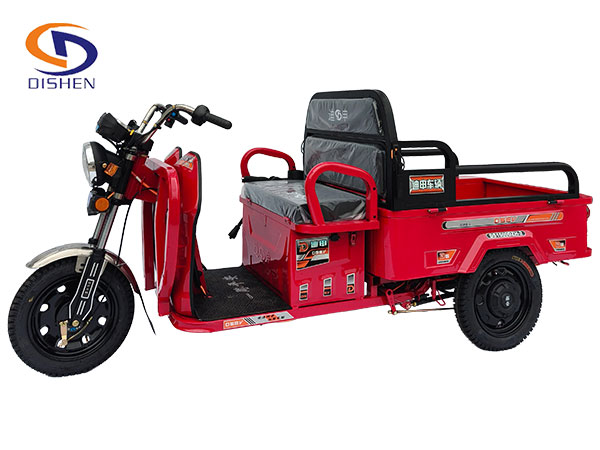
High stop frequency and short, repetitive trips
The defining characteristic of South Asian urban logistics is not distance but repetition: dense traffic, many stops, heavy loading and unloading, and tight delivery windows. A vehicle may cover a modest number of kilometres in a day while starting, braking and manoeuvring hundreds of times. That puts low-speed torque, brake durability, turning radius and charging turnaround ahead of top speed or long-range capacity.
Specify the vehicle around the shift, not the map. Work out how many stops, how long each stop takes, how the cargo is loaded, and how much time the vehicle has at the depot between shifts. Those numbers determine whether overnight charging is sufficient, whether a second battery or a midday top-up is needed, and whether the cargo body should open from the side, the rear or both. A loading pattern that saves 20 seconds per stop is worth more than an extra 20 km of nominal range.
Monsoon conditions add a second constraint. Standing water, high humidity and heavy dust in the dry season all affect connectors, braking and body finish. Enclosed boxes protect textiles, parcels and retail stock, but need drainage and ventilation. For agricultural and wholesale market work, an open or reinforced bed with a simple, repairable structure is often easier to keep in service. Many buyers split the fleet by cargo type rather than forcing one body to do everything.
Specification decisions for dense urban duty cycles
Read the table as a set of decisions to settle in order for South Asia, not as a product comparison. For each row, ask the supplier what assumption sits behind their recommendation; two offers can quote the same payload while assuming very different road surfaces and shift lengths.
| Decision | Practical starting point | What to verify |
|---|---|---|
| Payload | 400-900 kg planning band for short, frequent trips | Actual cargo density, not just gross weight |
| Drive feel | Low-speed torque, tight turning radius, predictable braking | Behaviour fully loaded in stop-start traffic |
| Cargo body | Enclosed lockable box for parcels and textiles; open bed for market goods | Door layout and loading time per stop |
| Battery | Capacity sized to the shift plus a wet-season reserve | Whether depot charging fits the turnaround window |
| Brakes and tyres | Specify for repeated full-load stops and wet surfaces | Wear part availability and replacement interval |
| Weather protection | Sealed connectors, drainage, treated frame and fasteners | Warranty position on water exposure |
| Spare parts | Brake, tyre, controller, charger and lamp stock with part numbers | Local workshop capability |
Five checks to run before requesting a quotation for South Asia
These five checks are worth doing before any money moves on a South Asia order. They cost an afternoon and usually expose the gaps that become expensive after a container has arrived: an unstated body weight, an unmatched charger, or a parts list with no part numbers.
- Write down stops per shift, kilometres per shift and hours available for charging. Ask the supplier to confirm the configuration against those three numbers.
- Time a full loading and unloading cycle with a sample cargo box; door layout determines real productivity.
- Confirm the payload rating with the chosen body fitted and with the driver and any helper aboard.
- Ask for the wet-season protection details for connectors, controller and frame finish in writing.
- Order wear parts with the vehicles. Brake and tyre consumption is high on short, high-frequency routes.
Packing, shipping and spare-parts plan for South Asia
Imports typically arrive through major container ports and move into dense urban distribution networks, so documentation accuracy and carton marking matter more than transit speed. Knocked-down packing reduces freight per unit and is practical where the importer has assembly capability; the trade-off is tooling, workspace and quality control at destination. Ask for an assembly checklist and a torque specification for the fasteners, and keep one unit unassembled as a reference during the first batch.
One mistake worth avoiding. Buyers often over-specify battery capacity to compensate for congestion. Range is rarely the binding constraint on a short, repetitive route; charging turnaround and brake and tyre wear are. Spend the budget on serviceable components and a parts kit instead.
Where to go next when sourcing for South Asia
Nothing here replaces a specification sheet for your own South Asia operation. Take the route, load and charging figures from this page, put them in an enquiry, and judge the reply by how specifically it answers them. The guides below cover verification, costing and packing in more detail.
Country buying guides for South Asia
Both markets share short, high-frequency urban routes, but differ in climate, cargo type and how far a vehicle travels between depot and delivery zone.
- Bangladesh - Dhaka congestion, textile and bale dimensions, and monsoon water exposure
- Pakistan - sustained heat, dust and longer intercity legs alongside city work
Market Overview
South Asia includes markets such as Pakistan, Bangladesh. Electric cargo tricycles are used where businesses need practical short-distance cargo transport with controlled operating cost.
This page is educational and intended to help importers, distributors, and fleet buyers compare electric three-wheelers with fuel vehicles and other small cargo vehicles.
Road Conditions and Local Transportation Challenges
South Asian routes can include high traffic density, warm weather, mixed road quality, and frequent short-distance commercial trips. Payload, motor torque, braking, and serviceability are major selection points.
Buyers often compare electric three-wheelers against fuel vehicles by operating cost, maintenance complexity, and charging availability.
Business Applications
- Market goods transport
- Textile and retail distribution
- Courier service
- Agricultural collection
- Urban utility work
Recommended Product Directions
| Use case | Suggested vehicle configuration |
|---|---|
| Courier and parcel delivery | Enclosed cargo box, lockable rear body, optional company color and logo, route range planning. |
| Agriculture and market goods | Open cargo bed or reinforced cargo body, higher payload planning, durable tires. |
| Municipal and facility services | Utility body, compact turning radius, service-friendly components. |
Related Buying Guides
FAQ
Why are electric cargo tricycles suitable for South Asia?
They support short-distance commercial transportation with lower daily energy and maintenance complexity compared with many fuel vehicles, especially when routes are predictable.
What buyers should evaluate in South Asia?
Buyers should evaluate payload, route distance, charging access, road conditions, cargo body design, spare parts, and aftersales planning before ordering.
Which customer types are most relevant?
Relevant buyers include distributors, wholesalers, fleet operators, courier companies, agricultural buyers, municipal users, and commercial transport businesses.