Last-Mile Delivery Tricycles for Africa: Spec Guide
Last-mile delivery is the most demanding duty cycle a cargo tricycle can be put to, and the one most often specified badly. A vehicle that works fine for a market trader carrying goods 20 km a day will fail within months on a courier route doing 90 km with 200 stops.
This guide is written for fleet operators and distributors building or replacing a delivery fleet. It covers the four inputs that determine fleet size, the cargo body choices that matter for parcel work, and the specifications that actually break under daily stop-start service.
What makes last-mile different
Three characteristics separate last-mile work from general cargo hauling, and each changes the specification.
Stop density. A courier vehicle may stop 60â120 times a day. Every stop is a motor start under load, a brake application and a door opening. This punishes controllers, brakes and door hardware far more than distance does.
Fixed time windows. Delivery commitments do not move. A vehicle that is 15 minutes late every morning because charging ran long is a business problem, not an inconvenience. Charging strategy becomes an operational requirement rather than a cost decision.
Load profile that changes through the day. A parcel vehicle leaves full and returns empty. That means the suspension and brakes are working hardest in the first two hours, and the vehicle is at its least stable when it is most heavily loaded.
A vehicle specified for average load rather than peak load will be overloaded every morning.
Sizing the fleet: four inputs
Fleet size is not a guess. It comes from four numbers, and importers who collect them before ordering consistently end up with a smaller, cheaper fleet than those who order by intuition.
1. Daily route distance in kilometres. Not the straight-line distance â the actual driven distance including backtracking. Measure it for a week; it is usually 20â30% higher than the estimate.
2. Stops per route. Drives the time-per-delivery calculation and the wear on doors, brakes and controllers.
3. Peak parcel load in kilograms and cubic metres. Both matter. A light but bulky load needs cargo volume; a dense load needs payload capacity. These lead to different vehicles.
4. Recharge window available. How many hours per day can a vehicle actually be plugged in, and is that window predictable?
From these four, fleet size follows: daily route distance divided by usable range per charge, plus a spare ratio for maintenance. A 10â15% spare ratio is typical for a working fleet; below that, one breakdown removes a route.
Choosing the cargo body
For parcel and courier work, the body is more consequential than the chassis.
Enclosed box body. Protects parcels from rain, dust and theft. This is the standard choice for courier fleets, and for good reason â cargo damage and pilferage are the two costs that destroy last-mile margins. The trade-off is container loading efficiency: Dishen ships 21 units per 40HQ for the BP enclosed-box model, against 50 for standard cargo tricycles with knocked-down boxes.
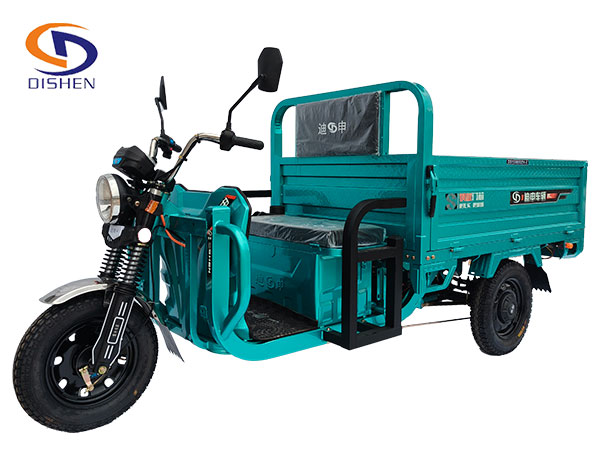
Flatbed with side rails. Cheaper, lighter, easier to load fast. Suitable where goods are robust and routes are short. Common for wholesale distribution and agriculture rather than parcel networks.
Canopy or semi-enclosed. A middle option â protection from sun and light rain without a full box. Often used where heat is a bigger problem than rain, which applies across much of West Africa and the Gulf.
Whichever body you choose, confirm the actual internal dimensions rather than the nominal bed length. Cargo beds come in six lengths â 1.3 m, 1.5 m, 1.6 m, 1.8 m, 2.0 m and 2.2 m â with the 1.5 m and 1.6 m beds measuring 1,500 Ã 1,100 mm and 1,600 Ã 1,100 mm. Bed length is not the same as payload rating, and it is not the same as overall vehicle dimensions.
Range and charging strategy
Published range figures are almost always measured unladen on flat ground. Real last-mile range is lower, sometimes by a third.
Three factors cut range in service: payload (a full parcel load), terrain (unpaved roads and gradients), and stop density (repeated acceleration from rest draws more current than steady cruising).
The practical approach is to plan for 60â65% of the quoted range as usable daily range, then size the fleet against that figure. If that produces an uneconomic fleet, the answer is usually a charging strategy rather than a bigger battery.
Charging options, in order of cost-effectiveness:
- Overnight depot charging. Cheapest per kWh. Works if routes fit within one charge.
- Opportunity charging at midday. A second pack or a top-up during the lunch lull extends daily range without buying a larger battery.
- Battery swap. Dishen offers battery-swap-compatible platforms. This is the right answer for high-utilisation fleets where vehicles must run two shifts, but it requires operational discipline â charged packs must be ready when the vehicle returns.
- Generator charging. The most expensive per kWh. Sometimes unavoidable, but it should be a fallback, not the plan.
Specifications that fail in last-mile service
These are the components that consistently cause problems on high-stop-density routes. Specify them explicitly rather than accepting what a quotation implies.
| Component | What fails | What to specify |
|---|---|---|
| Controller | Overheating from repeated acceleration under load | Confirm continuous current rating, not peak |
| Brakes | Rapid wear from 100+ stops per day | Ask for brake type and expected service interval |
| Rear axle | Bearing and shaft wear under constant load | Confirm rated load capacity, not vehicle payload |
| Door hardware | Hinges, latches, seals on box bodies | Ask whether hardware is serviceable locally |
| Tyres | Sidewall damage on unpaved approaches | Match tyre type to your actual road mix |
| Wiring and connectors | Vibration and moisture ingress over time | Confirm IP rating on controller and connectors |
Ask every supplier the same questions in writing. A supplier who cannot answer the controller current rating question has probably not thought about last-mile duty cycles.
Container math for fleet buyers
Fleet orders are where loading configuration changes the economics most.
Dishen quotes EXW â you arrange ocean freight, and rates vary by destination port and season. That is exactly why loading configuration matters: it is the part of the freight equation you control at quotation stage.
The arithmetic is a simple division. Whatever 40HQ rate your forwarder quotes, freight per vehicle is that rate divided by the number of units in the container:
| Loading configuration | Units per 40HQ | Freight per unit, as a share of the container rate |
|---|---|---|
| Fully assembled (typical industry) | 8â16 | 6.3%â12.5% of the rate |
| Dishen BP enclosed box | 21 | â 4.8% of the rate |
| Dishen standard cargo, knocked down | 50 | 2% of the rate |
In other words: at any given 40HQ rate, loading 50 units instead of 16 cuts freight per tricycle by roughly two-thirds â and instead of 8, by roughly six-fold. For a 20-vehicle fleet, that difference is usually larger than the per-unit price gap between two suppliers. It is the single most under-examined line in most import budgets.
Knocked-down shipment requires assembly at destination. For a fleet operator with a workshop this is routine; for one without, factor in the labour or ask for SKD rather than CKD.
Spare parts are part of the fleet, not an add-on
A fleet of 20 vehicles will need parts. The question is whether those parts are in your warehouse when a vehicle fails, or on a ship.
For fleet orders, a matched spare-parts package covering the components in the table above is not optional. The alternative â sourcing individual parts after failure â produces exactly the downtime that erases the running-cost advantage of electric vehicles.
Dishen supplies matched spare-parts packages alongside vehicle orders, sized to the fleet. It is worth specifying this at quotation stage rather than after the first failure, because the parts are far cheaper when shipped in the same container.
A specification sheet you can send to suppliers
Copy this and fill it in before requesting quotes. Identical requests are the only way to compare quotes honestly.
Send this to three suppliers. The differences in their responses â particularly who asks follow-up questions and who does not â tell you more than the price column.
Frequently asked questions
How many electric tricycles do I need for a delivery route? Divide daily route distance by usable range per charge (plan on 60â65% of the quoted figure), then add a 10â15% spare ratio for maintenance. Collect real route data for a week first â estimates are usually 20â30% low.
Can an electric tricycle do 100 km a day? Some can, but not on a single charge with a full load on mixed terrain. Routes at that distance normally need either a larger pack, midday opportunity charging, or a battery-swap configuration.
Box body or flatbed for parcel delivery? Box body, in almost all cases. The protection against rain, dust and pilferage is worth the loading-efficiency loss, and cargo damage is a larger cost than freight for most courier operations.
How many units fit in a 40HQ? Dishen ships 50 standard cargo tricycles per 40HQ with cargo boxes knocked down and frames nested, or 21 units for the BP enclosed-box model. Most suppliers shipping fully assembled fit 8â16.
What lead time should I plan for? Approximately 100 days from order confirmation to shipment readiness, covering production, container loading and vessel booking. Add your own ocean transit and customs clearance time on top.
Is there a minimum order for fleet purchases? Standard 1.5 m and 1.6 m cargo beds have no MOQ. Other bed lengths require 50 units or a full 40HQ. OEM/ODM configuration is available above 500 units.
Next step
Send us your route profile â distance, stops, payload, terrain, charging window â and we will come back with a recommended vehicle specification and fleet size, including the loading configuration that gives the lowest freight per unit. If your numbers point to a different vehicle type entirely, we will say so.