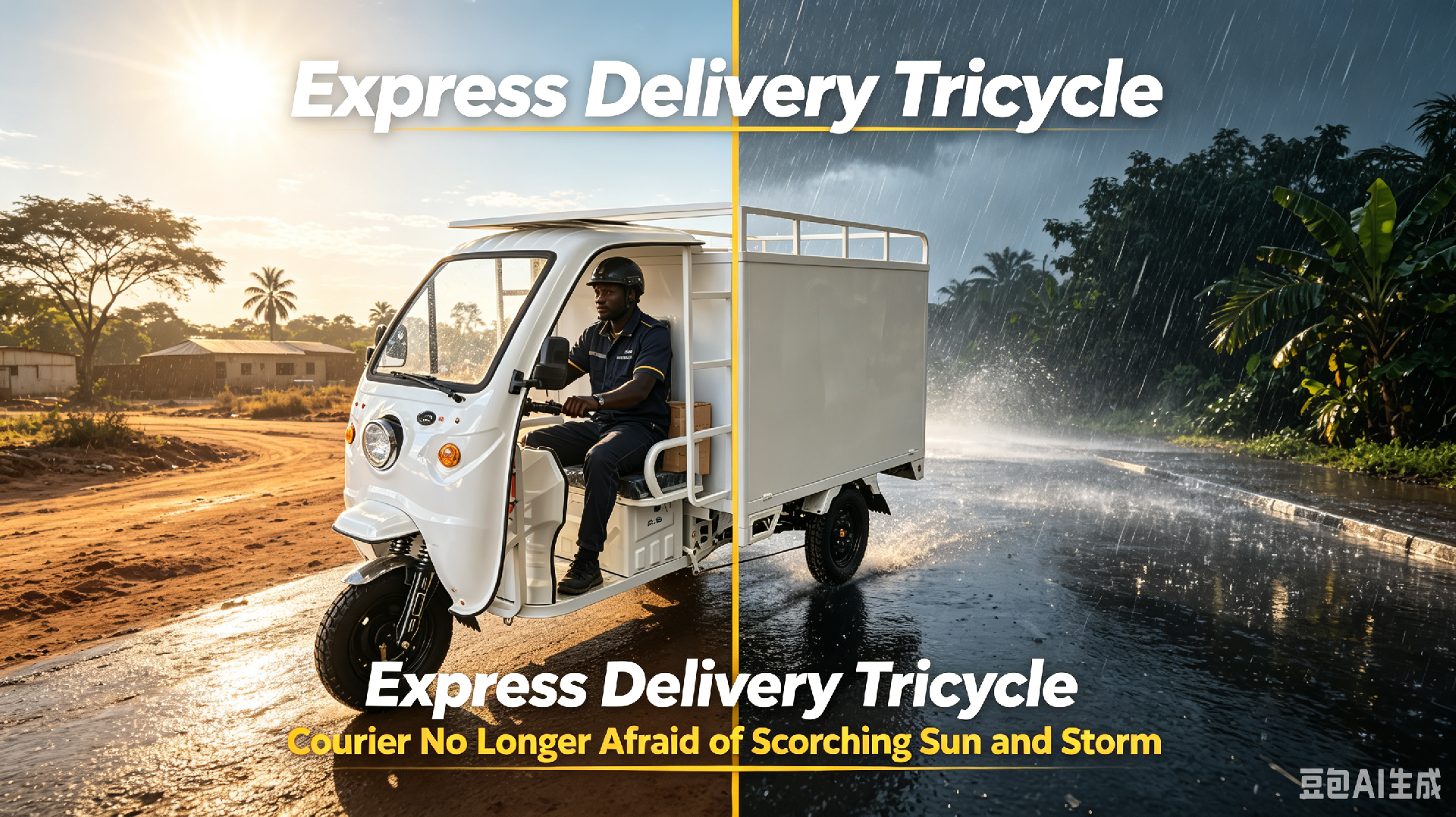
Direct Answer: Where a Cargo Tricycle Fits in a Delivery Fleet
For logistics companies, the procurement decision should start with route data rather than a catalogue headline. A suitable vehicle must match real cargo volume, loaded road conditions, charging time, maintenance access and the cost of downtime. A pilot on one representative route is usually more informative than choosing only by maximum speed or advertised unloaded range.
1. Fleet Use Cases
Courier and parcel delivery
Enclosed or lockable cargo bodies can protect parcels on dense routes with repeated stops.
Retail replenishment
Open beds or customized boxes can move cartons and supplies between a depot, stores and local customers.
Food and grocery distribution
Body layout should reflect crate dimensions, hygiene needs, weather protection and loading frequency.
Industrial and campus logistics
Short internal routes can benefit from predictable charging, simple operation and standardized parts.
2. Match Payload and Route Before Selecting a Model
| Fleet data | Why it changes the specification | What the buyer should provide |
|---|---|---|
| Daily route distance | Determines usable battery capacity, reserve margin and charging schedule. | Loaded daily distance, longest route and return-to-depot pattern. |
| Payload and cargo volume | Weight and dimensions affect body design, frame demand and loading efficiency. | Typical and peak weight, parcel dimensions and loading method. |
| Road and terrain | Grades, rough surfaces and water exposure affect torque, tires, suspension and brakes. | Road photos, typical grade, surface type and weather conditions. |
| Stop frequency | Frequent acceleration and braking change energy use and brake requirements. | Average stops per route and time spent loading at each stop. |
| Service environment | Parts availability and technician capability affect uptime after delivery. | Local workshop capability and preferred initial spare-parts stock. |
3. Lead-Acid vs LiFePO4 Battery Planning
There is no universal battery choice for every logistics fleet. Lead-acid batteries can reduce initial vehicle cost and may be easier to replace in some markets. LiFePO4 batteries can reduce battery weight and may provide longer cycle life when operated and charged correctly. Procurement teams should compare the complete route and service plan.
- Calculate range using loaded routes, road grade, stop frequency, temperature and reserve margin.
- Confirm charging voltage, local grid conditions, charging time and the number of vehicles sharing each charger.
- Request the battery cell manufacturer, warranty scope and model-specific shipping documents before ordering.
- Confirm cold-weather or hot-weather operating requirements for the destination market.
4. Spare Parts and After-Sales Planning
A reliable electric freight tricycle wholesaler should discuss service planning before shipment, not only after a breakdown. The first order should include a spare-parts list based on vehicle quantity, expected use and local availability.
Initial service kit
Agree on wear parts, electrical parts and body hardware that should travel with the first shipment.
Warranty workflow
Define evidence required for a claim, response time, replacement-part handling and exclusions.
Technical documents
Request operating, maintenance, wiring and assembly information for the selected configuration.
Local service readiness
Assign a workshop or distributor technician and plan basic training before fleet deployment.
5. CBU, SKD or CKD Export Delivery
| Format | Operational benefit | Buyer responsibility |
|---|---|---|
| CBU | Lower assembly work after arrival and easier pilot deployment. | Confirm assembled-vehicle import rules and container efficiency. |
| SKD | Can improve container use while limiting assembly complexity. | Provide trained staff, tools and a repeatable assembly check. |
| CKD | May support higher container density and local assembly strategy. | Plan assembly process, quality control, local compliance and parts traceability. |
Container quantity cannot be confirmed without the exact model, cargo-body dimensions and packing method. Buyers should request a model-specific loading plan rather than rely on a general container estimate.
6. Questions to Send With a Factory RFQ
- What country, destination port and vehicle classification will apply?
- What is the typical and maximum payload, including cargo dimensions?
- How many kilometers and stops does the vehicle complete each day?
- What roads, gradients, temperatures and weather will the vehicle face?
- Is lead-acid or LiFePO4 preferred, and what charging access is available?
- Is an open bed, enclosed box, hydraulic dump body or another body required?
- What order quantity, OEM branding and CBU, SKD or CKD format is planned?
- Which local certificates and battery transport documents are required?
7. About Dishen Technology
Sichuan Dishen Technology Co., Ltd. is based at No. 26, Chuangzao 1st Street, Economic Development Zone, Yingshan County, Nanchong City, Sichuan Province, China. The company has operated in Sichuan for 20 years and reports annual production capacity of 50,000 electric tricycles.
Dishen can discuss electric cargo, delivery and passenger tricycles, OEM configuration, spare-parts planning and CBU, SKD or CKD export. The current stated warranty is one year for the motor, controller and rear axle and three years for the lithium battery. Dishen does not currently claim EEC, ISO or CE certification, so destination-country and model-specific requirements should be confirmed before quotation and production.
Electric Cargo Tricycle Fleet FAQ
When is an electric cargo tricycle suitable for a logistics fleet?
It is suitable for short or medium urban routes with frequent stops, predictable depot charging and loads that exceed motorcycle capacity but do not require a van.
How should a fleet choose payload and cargo-body size?
Use measured route data: typical cargo weight, parcel dimensions, loading frequency, road grade and driver access. Rated payload alone is not enough.
Should logistics companies choose lead-acid or LiFePO4 batteries?
Lead-acid can reduce initial purchase cost, while LiFePO4 can support lower weight and longer cycle life. Compare route distance, charging schedule, climate, replacement cost and local service capability.
What after-sales information should a buyer request?
Request warranty scope, spare-parts lead time, recommended initial service kit, diagnostic support, maintenance documents and a clear process for reporting failures.
What is the difference between CBU, SKD and CKD delivery?
CBU vehicles arrive assembled, SKD vehicles arrive partly disassembled and CKD vehicles require more local assembly. The choice affects container use, assembly labor, quality control and local import rules.
What should a logistics company send before requesting a quotation?
Send the country, destination port, daily distance, payload, cargo dimensions, road conditions, charging access, preferred battery, quantity, packing method and local certification requirements.
Request a Route-Based Configuration
Send your fleet route, payload, cargo dimensions, battery preference, quantity and destination port. Dishen can use that information to discuss a suitable configuration and a pilot or shipment plan without relying on unsupported range or cost assumptions.